The Riemann Hypothesis, Part 2, Was It Proven?
On November 20, Levent Alpöge announced a proof of the Riemann hypothesis that he developed with Claude. On November 21, the Lean and Mathlib teams reported that independent checkers accepted the formal proof of the standard statement. That’s a big deal. Clay still lists the problem as unsolved as of November 21. I also saw talk of an earlier disproof on Polymarket, so I wanted to find out what each of these claims meant. Lean and Mathlib’s statement · Clay’s status page
The line to remember is the one through ½, where every nontrivial zeta zero has to sit.
What Alpöge Announced And How It Was Checked
What Lean Does
Lean is a tool for writing mathematical proofs in a form a computer can check. You tell it exactly what you want to prove and give it an argument. Lean’s core checker, called the kernel, verifies that the conclusion follows from the definitions, theorems, and assumptions the argument uses. How Lean validates proofs
Mathematicians already have ways to build those arguments. In a direct proof, you start from what you know and work toward the claim. In a proof by contradiction, you assume the claim is false and show that this leads to something impossible. In induction, you prove the first case and show why each case implies the next, like knocking over a row of dominoes.
The same techniques work in Lean. In my thesis, I remember borrowing a step from a paper that said it was obvious. So I wrote that it was obvious too. My supervisor asked me to derive it, and it took a lot more space than the word “obvious.” Lean makes you supply the work behind that sentence, or use a tool that can reconstruct it for the checker.
What Alpöge and Claude Built
Alpöge says he guided the work from a simpler problem toward the one they needed to solve. He credits Claude with important mathematical ideas along the way. One example was figuring out how to combine tools called theta lifts to adapt an earlier method from a different setting. They developed the argument and formalized it as a Lean library of roughly 17 million lines. That includes definitions, existing results written in Lean, and intermediate results the new argument needs. Mathlib supplied a foundation, including the statement of the Riemann hypothesis itself. The 250,000-page figure Alpöge mentions was from an attempt at a prose write-up. What he released was the Lean library. Alpöge’s announcement · The Lean community’s verification report

Main.lean
theorem riemannHypothesis : RiemannHypothesis :=
rhOfAll
Supplements/Kernels/MainTheorems.lean
theorem rhOfAll : RiemannHypothesis :=
Formalism.VW.rh_of_every allChi
What The Human Brought
Could you and I open Claude and hammer-solve the Riemann hypothesis? I don’t think so. You still have to be a good prompter (haha). Here that meant knowing enough mathematics to see which analogy was worth pursuing and what question to ask next.
We could bring an A4 sheet of notes to my measure theory exam. Anything we wanted. It could tell me what a theorem said. I still had to figure out which theorem would help and what to ask next. I thought of that while reading Alpöge’s account. #### What Stepanov Did With Polynomials
There’s a version of this story where you count points on a curve over a finite field. Think of trying all the possible coordinates in arithmetic modulo a prime and asking which pairs solve the equation of the curve. Stepanov’s trick was to build a new function that vanishes at those points, with each zero using up several degrees at once. Here’s the idea in a toy example.
The polynomial has degree six. Its zero at 2 uses up three of those six degrees, and its zero at 5 uses up the other three. That’s multiplicity. If you can build a nonzero polynomial of degree at most 60 that vanishes at least three times at each point you want to count, you can have at most 20 such points. The hard part is building the auxiliary function with both properties. That’s how a polynomial can give you a ceiling on a count. An exposition of Stepanov’s method
What Theta Lifts Do In This Argument
Alpöge wanted something that could do the job of repeated zeros when the objects he cared about were integers and primes. A theta lift takes an automorphic form, a function with particular symmetries, and transfers information from it to a new form. In this construction the output of one lift becomes the input of the next. The chain builds up divisibility at selected primes. That divisibility plays the role of repeated vanishing in the earlier argument.
Counting points on a curve
Build a function with repeated zeros. Its degree limits how many points it can cover.
Bounding a sum over primes
Chain theta lifts to build divisibility. A geometric inequality limits how much can build up.
Alpöge says he guided the search toward a setting where the analogy could work. Claude suggested using about lifts when the prime sum has cutoff . The exact chain and the inequality that controls it are where the technical work is. Alpöge’s note · The technical guide, section 4
What The Proof Actually Does
The proof rules out nontrivial zeros to the right of ½. The mirror symmetry from Part 1 then rules them out on the left. To make the right-hand side empty, Alpöge and Claude turned the zero question into a question about how big a weighted sum over primes and prime powers can get. Siniša Slijepčević’s outline of the proof
Build a ceiling. The theta lifts build up divisibility. Geometry limits how much can build up, so a weighted sum over primes has a ceiling on certain long stretches of cutoffs.
Combine the sums. The bound arrives for several related prime sums together. They combine them with positive weights so a zero’s signal survives in the combined sum.
A zero on the right would break the ceiling. The Landau argument says an off-line zero to the right would force the sum above the ceiling somewhere in every sufficiently late stretch. The bound gives stretches where it stays below.
Reflection takes care of the left. A zero on the left would have a partner on the right. With the right side ruled out, the nontrivial zeros sit on the line through ½.
The two halves of the proof meet at the ceiling. Geometry says the sum stays below it on certain stretches. Analysis says a zero too far to the right would make that impossible. The ceiling can grow like a power arbitrarily close to the square-root scale, which is what lets the argument get all the way down to ½. Technical guide, sections 2–5
See the technical guide’s full proof map
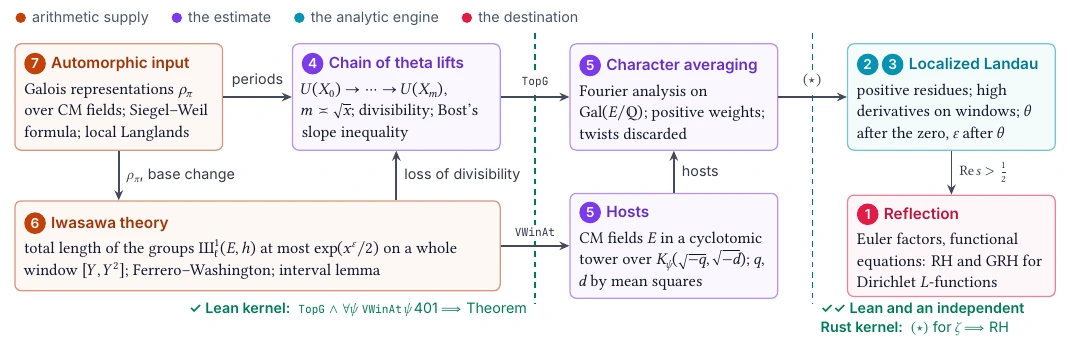
“Chain of theta lifts” builds the ceiling. “Character averaging” combines the sums. “Localized Landau” turns the ceiling into a region without zeros. “Reflection” brings that result to the other side. Technical guide, page 1.
Michael Rubinstein also posted a 164-page working draft on November 21 that explains the argument for the ordinary zeta function. It gives readers a way into the mathematics behind the checked code. Rubinstein’s working guide
What Did They Actually Bound?
Take a cutoff of 10. The primes and prime powers below it are 2, 3, 4, 5, 7, 8, and 9. For each number, take the natural log of its base prime and multiply by (10 divided by the number, minus 1). For 4, the contribution is
Adding all the contributions gives about 9.11. Subtract the smooth trend, about 7.25, and the excess is about 1.86. The bound is a ceiling on that excess. The proof needs ceilings much farther out than 10. The weighted sum in the technical guide
Where The Geometry Comes In
If a positive integer is divisible by 4 and by 3, it has to be at least 12. Turn that around. If you know it’s at most 20, there’s a limit to what can divide it. Take logs and those prime factors give you a sum. The proof uses a much more sophisticated version of that idea. The theta lifts come from the theory of automorphic forms and create divisibility at selected primes. An inequality about lattices from arithmetic geometry, called Bost’s slope inequality, limits how much divisibility there can be. That limit helps bound the prime sums. Technical guide, sections 4–6
How They Checked This Proof
First, did the claim actually say what we mean by the Riemann hypothesis? Mathlib is a shared library of mathematics written in Lean. It already had an exact statement of the hypothesis for the reviewers to compare with the conclusion in Alpöge’s proof. Two independent tools confirmed they matched.
If you’ve never seen Lean, here’s the same claim both ways.
In English. Every nontrivial zero of zeta has real part ½.
In Lean. Here’s that claim laid out one condition per line.
∀ s : ℂ,
  riemannZeta s = 0 →
  (¬ ∃ n : ℕ, s = -2 * ((n : ℂ) + 1)) →
  s ≠ 1 →
  s.re = 1 / 2
Read the last line first. s.re = 1 / 2 says the horizontal coordinate of s is ½. The first line says “for every complex number s.” The arrows say the conclusion follows if all three conditions hold. Zeta has to be zero at s, s can’t be one of the already known zeros −2, −4, −6, …, and s can’t be the pole at 1. One difference is that English can tuck those details into the word nontrivial. Lean needs each condition stated precisely. The formal statements the reviewers checked
Second, did the argument prove that claim? Multiple people rebuilt the library and reproduced the same proof export. In one run, Sutherland’s team rechecked all 175,187 compiled modules in Lean’s kernel. Independent checkers also verified the full exported proof as a whole. Andrew Sutherland’s audit found that the theorem uses only Lean’s three standard axioms. The export let reviewers check the underlying proof separately from the code that produced it. Sutherland also reports an independent sandboxed rebuild with an identical export. His log separates finished checks from some end-to-end comparator and export replays that were still running. Buzzard’s four checks · Sutherland’s verification records
- Check the statement. Compare the conclusion to Mathlib’s formal statement of the hypothesis.
- Replay the modules. Rebuild the library and recheck 175,187 compiled modules in Lean’s kernel.
- Check the export independently. Give the full proof object to other checkers.
Some checks zoomed in on one link at a time. An independent reading project isolated the step from the prime-sum bound to the Riemann hypothesis and checked it in two proof checkers. That check takes the bound as a premise. The full proof also supplies the argument for the bound itself. The isolated checks and their premises
The release also covers the generalized hypothesis for Dirichlet L-functions, a family of functions related to zeta. Sutherland’s audit includes those statements too. The exact statements checked
Was It Disproved Already?
I checked the public comments on Polymarket’s markets for independent verification, a Clay declaration, and further progress. I couldn’t trace the older disproof claim to a specific post. I did find two actual manuscripts that we can read.
- January 2025. Huan Xiao claimed that two older results about weighted prime sums contradict each other if the Riemann hypothesis holds. The argument needs an oscillation in one count to survive a smoothing step. Equation 3 is where the preprint makes that jump, with no detailed justification there. The preprint page labels this version as unreviewed. Xiao’s preprint, equations 1–3
- February 2026. Tatenda Kubalalika claimed something stronger than a single off-line zero. The working paper argues that zeros approach the right edge of the strip. Cambridge Open Engage identifies it as an unreviewed working paper. I couldn’t find independent verification of either disproof. Kubalalika’s working paper
What would settle it the other way? One nontrivial zero off the line, or a valid argument that such a zero exists.
What About Masullo’s Draft?
Ravi Vakil reported on November 20 that Alessandro Maria Masullo had a separate proposed proof of the generalized hypothesis and that Brian Conrad had been reviewing it. In the released manuscript, section 12.3 still has an instruction to fill in the section. That part is supposed to connect the calculation on the zero side with the one on the prime side. Without it, a reader has an argument with a step left to check. This is a question about Masullo’s proposed proof. Alpöge’s argument uses a different route. Vakil’s announcement · Masullo’s manuscript, section 12.3
Terence Tao described Alpöge’s Lean release and pointed readers to the verification discussion. Mathematician Sam Hopkins linked Vakil’s announcement about Masullo in the comments. Tao’s post and discussion
One Polymarket question asks whether independent verification happens by a deadline. A separate market asks whether Clay officially declares the problem solved by a deadline. Those are different events. As of November 21, the public evidence I can point to is the independent formal verification. Clay’s official status page still says unsolved. Its prize process requires publication in a qualifying outlet, a two-year wait, and broad acceptance by mathematicians. Clay’s prize rules · Verification market · Clay’s status page
Conclusion
Maybe this is me coping as a mathematician. I keep thinking about how much the way we do math has changed. We can count on our fingers. With a diagram we can see why something might be true. In Euclid you can see a whole system of geometry built by writing down what you assume and arguing from there. Centuries later, formal logic gave us an even more precise way to write down what follows from what. And now we can write a proof in Lean and have a computer check every step.
That last part matters to me. Alpöge could bring an intuition from another area of math. Claude could suggest a way to make it work. Lean gave them a language precise enough to turn the resulting argument into something other people could independently check. To me, the fact that those three things worked together is more interesting than the question of whether to call it AGI.
I don’t feel like math is over. I feel like we just got a new way to do it. We still get to ask weird questions. We might get further with them now.